The Hierophant Tarot Yes or No: Shadow Side, Warnings & The Dark Truth (What Auntyflo Won’t Tell You)
Fast Answer: The Hierophant Yes or No – The Harsh Truth
When you pull a single card for guidance, discovering the answer to “The Hierophant yes or no” can be incredibly confusing. Popular tarot websites, such as Auntyflo, frequently interpret The Hierophant as a straightforward, comforting “Yes.” They frame this card as the ultimate symbol of traditional marriage, spiritual guidance, divine approval, and positive commitment. They suggest that as long as you follow the rules, the universe is giving you a green light.
This interpretation is dangerously oversimplified. In reality, when evaluating The Hierophant yes or no meaning, the answer is far more often a restrictive “No” or a highly cautionary “Not yet.” This card frequently signals rigid tradition, intense conformity pressure, spiritual gatekeeping, and the expectation that you must sacrifice your individuality to fit in. Rather than granting you freedom, The Hierophant asks whether you are blindly obeying an external authority at the expense of your own soul. If your question involves authentic personal growth, breaking free from toxic cycles, or choosing an unconventional path, The Hierophant is not a “Yes”—it is a loud warning that you are about to step into a cage of someone else’s design.
The Hierophant Tarot: The Shadow Side & Hidden Warnings
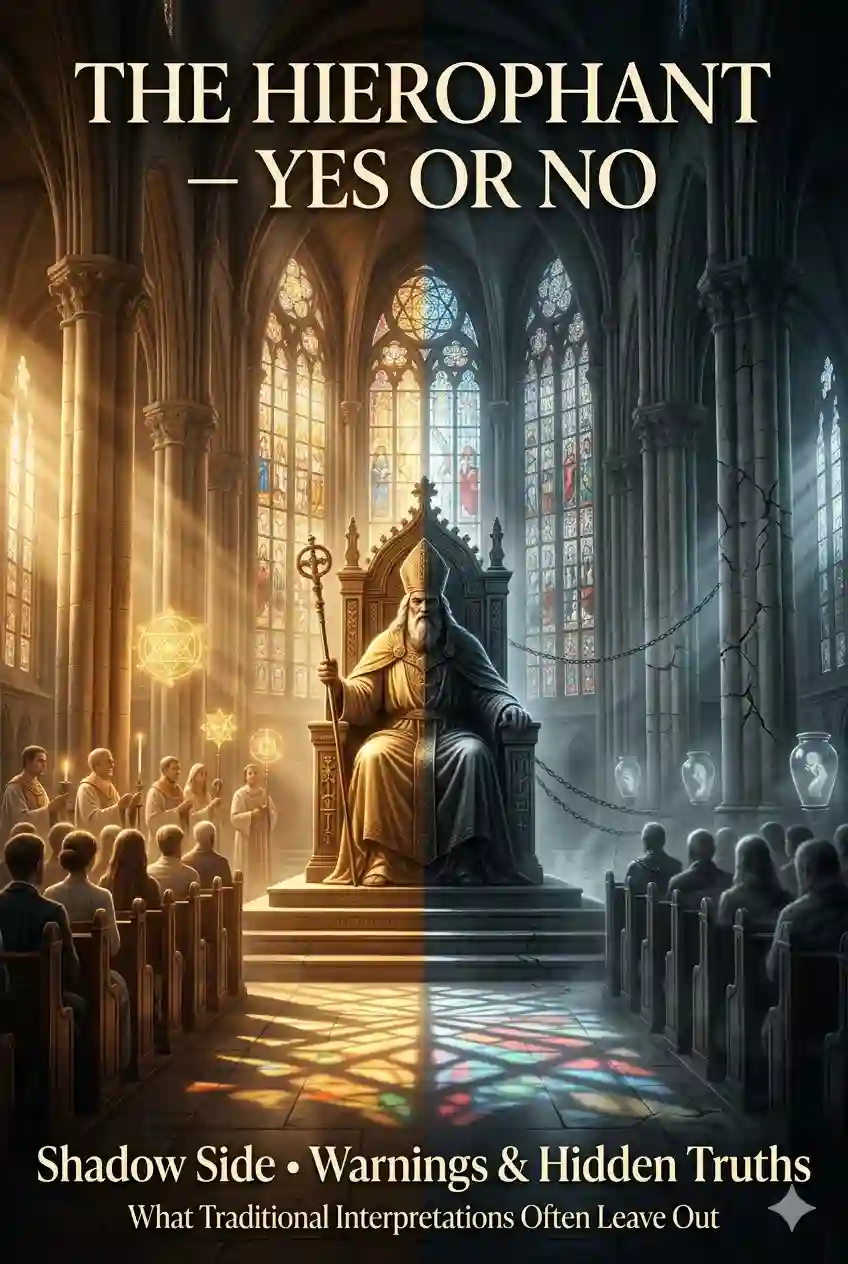
Look closely at the traditional imagery of The Hierophant. A massive, imposing religious figure sits elevated on a throne, flanked by two stone pillars, while two smaller acolytes bow in submission before him. He holds the keys to the kingdom, dictating who gets in and who is cast out. While many readers see a benevolent teacher, the Hierophant shadow side reveals one of the most double-edged power dynamics in the Major Arcana.
The dark truth of The Hierophant is rooted in dogmatic control, institutional power, and the profound fear of deviation. This card represents the massive, crushing weight of “the way things have always been done.” It warns of environments where questioning the leader is viewed as a sin, and where your worth is measured entirely by your ability to conform. Contrasting sharply with Auntyflo’s positive yes/no framing, the shadow of this card highlights how institutions—whether religious, corporate, or familial—can weaponize guilt and shame to keep you compliant. The warning is clear: do not mistake the comfort of belonging for the truth of your own spirit.
Introduction: Why The Hierophant Is Not Always a Positive “Yes”
Modern tarot spreads have a tendency to soften the sharp edges of the cards. Many readers have simplified The Hierophant tarot meaning into convenient buzzwords: “marriage = yes,” “going to school = good,” or “joining a group = positive.” We crave the validation that comes from doing the “right” thing, and we want to believe that following a set path will guarantee our safety and happiness.
However, ignoring the dark side of this card leaves you vulnerable to spiritual authoritarianism. Following the rules does not guarantee a fulfilling life; it only guarantees a predictable one. When you automatically read The Hierophant as a positive “Yes,” you risk staying stuck in outdated systems that actively harm you. You might remain in a loveless marriage because society expects it. You might endure a toxic corporate job because it looks good on a resume. You might suppress your authentic desires because your family or religion deems them unacceptable. The Hierophant warns that staying within the lines often requires the quiet, painful amputation of your true self.
Spiritual Meaning of The Hierophant – The Cautionary Message
On a profound spiritual layer, The Hierophant represents an ultimate test of discernment. Are you following your own soul, or are you worshiping external dogma? The cautionary message of this card revolves around spiritual bypassing. It is incredibly easy to hand over your spiritual autonomy to a guru, a priest, or a rigid belief system so you do not have to do the heavy lifting of self-discovery.
The Hierophant points to the danger of avoiding true leadership by following the crowd. When you look outside yourself for all the answers, you silence the divine voice within. This card frequently appears for individuals dealing with religious trauma, indicating a past where God was used as a tool for manipulation and fear. The spiritual test here is recognizing that you hold your own keys. You must undergo a symbolic death of old traditions and inherited beliefs in order to resurrect your genuine spiritual connection.
Psychological Interpretation: Conformity, Authority Issues & Fear of Rebellion
Psychologically, The Hierophant corresponds to the Freudian concept of the superego—the part of the mind that internalizes cultural rules, morality, and parental expectations. When The Hierophant appears in its shadow aspect, it indicates that your superego has become a tyrant. You are exhausted from constantly performing “goodness” according to metrics you did not choose.
This intense drive to conform usually stems from a fear of breaking from tradition and the subsequent terror of being rejected by the tribe. Humans are biologically wired to seek community; being ostracized historically meant physical death. Today, it translates to profound anxiety caused by rigid expectations. The card reflects unresolved authority issues, where an individual either blindly obeys authority figures (bosses, partners, parents) or chaoticly rebels against them. Ultimately, it reveals the deep identity loss under conforming pressure, showing how you might have forgotten who you are beneath the uniform you wear.
Symbolism Table: Positive vs. Shadow Meanings of The Hierophant
| Symbol / Concept | The Auntyflo / Traditional “Positive” Spin | The Real Shadow Meaning & Warning |
|---|---|---|
| The Pope Figure | Wise teacher, spiritual guide, mentor | Authoritarian leader, spiritual gatekeeper, dogmatic controller |
| Two Keys | Unlocking divine knowledge, spiritual truth | Gatekeeping access, controlling who is “worthy,” withholding information |
| Two Acolytes | Eager students, community, shared belief | Blind followers, cult mentality, loss of individuality, submission |
| Stone Pillars | Structure, stability, strong foundations | Inflexibility, rigid boundaries, inability to adapt or evolve |
| Hand Blessing | Divine approval, passing on wisdom | Demanding obedience, “do as I say,” conditional love and acceptance |
| Three-Tiered Crown | Mastery over mind, body, and spirit | Arrogance, superiority complex, spiritual inflation |
| The Number 5 | Expansion, learning, human experience | Conflict, crisis of faith, the friction between self and society |
| Marriage/Commitment | A blessed union, stability, loyalty | Staying out of obligation, societal pressure, loss of autonomy |
| Tradition | Honoring the past, cultural roots | Outdated rules, xenophobia, refusing to allow progress |
| Education | Higher learning, mastering a craft | Institutional indoctrination, debt traps, intellectual elitism |
| Belief Systems | A shared moral compass, ethical living | Guilt-driven obedience, religious trauma, toxic purity culture |
| Conformity | Fitting in, teamwork, harmony | Suppressing your true self, performing for others, losing your voice |
| Yes/No Outcome | A clear “Yes” if following the rules | Often a “No” for personal freedom; signifies an obstacle or trap |
| The Throne | Elevated perspective, respected authority | Untouchable power, lack of empathy, disconnected from the common person |
Common Hierophant Scenarios & Their Darker Interpretations
The Hierophant in Love/Relationships
Auntyflo will tell you this card means a traditional marriage is on the horizon. While true in some cases, the dark side reveals staying in toxic dynamics because they look “proper” to the outside world.
Case Study 1: Sarah pulled The Hierophant when asking if she should stay with her emotionally distant husband. Traditional readers told her it meant “Yes, honor your vows.” She stayed for five more years, experiencing intense feeling trapped by tradition and rules. The card was actually highlighting the societal pressure that was slowly crushing her spirit.
Case Study 2: Mark and David wanted a non-traditional partnership, but Mark’s family pressured them into a massive, traditional wedding. The Hierophant appeared as a warning that Mark was prioritizing his family’s image over his own relationship’s authentic needs.
The Hierophant in Career/Spiritual Path
In work, this card points to highly structured, often toxic corporate environments where “company culture” functions like a cult.
Case Study 3: Jessica asked if she should take a lucrative job at a major firm. The Hierophant appeared. She took the job, assuming it meant success. She soon found a culture of rigid micromanagement, zero creative freedom, and intense loss of control through blind obedience. She was a cog in a machine, just like the bowing acolytes.
Case Study 4: In spirituality, John followed a charismatic yoga teacher (The Hierophant). He surrendered his autonomy, ignoring red flags, only to realize the “guru” was financially exploiting the community.
The Hierophant as Yes/No Outcome
When you ask a direct question about breaking a habit, starting a weird business, or leaving a relationship, The Hierophant is usually a “No.”
Case Study 5: Anna asked, “Should I drop out of medical school to pursue art?” The Hierophant appeared. It was not a “Yes” to her art; it reflected the massive, looming institutional pressure of her current path telling her “No.” She had to consciously choose the reversed meaning of the card to actually break free.
The Hierophant Reversed
The Hierophant reversed is frequently painted as negative chaos. In reality, it is often the most necessary and liberating card in the deck. It represents the rebel, the iconoclast, and the person who finally walks away from the cult.
Case Study 6: David drew The Hierophant reversed when deciding whether to leave his strict religious community. While terrifying, the reversed card was his permission slip to embrace facing yourself beyond societal expectations and finally live his authentic truth.
Emotional States Reflected by The Hierophant
When The Hierophant’s shadow falls over you, the emotional landscape is bleak. You may feel a suffocating guilt for simply wanting something different than what you were taught. There is a deep, agonizing feeling of suffocation under rules that make no logical sense.
You might harbor intense suppressed anger at authority and dogma, yet feel completely unable to express it without facing excommunication from your family or peers. This leads to a quiet, internal rebellion that eats away at your peace. You experience spiritual emptiness—the terrifying realization that you have “done everything right,” checked every box, pleased every authority figure, and yet you are profoundly unhappy. It is the emotional state of a caged bird who has forgotten how to fly.
Life Situations That Trigger The Hierophant as a Warning
The Hierophant appears as a massive red flag in specific, highly controlled life situations:
- Family Enmeshment: When parents use financial support or inheritance as leverage to force a child into a specific career or marriage.
- Religious Trauma: When a church, mosque, or spiritual center demands absolute obedience and shames members for asking questions or expressing their sexuality.
- Corporate Cults: Workplaces that demand 80-hour work weeks, enforce mandatory “fun,” and punish anyone who attempts to establish a healthy work-life balance.
- Educational Debt Traps: Feeling forced to pursue a master’s or doctorate degree solely because “it is what is expected,” leading to massive debt and misery.
Spiritual Lessons from the Shadow Side of The Hierophant
What is this complex card actually trying to teach you? The true spiritual lesson of The Hierophant is that real growth requires questioning tradition, not blindly following it.
The Hierophant teaches the sacred art of discernment. You must learn the difference between true personal power vs external authority. It asks you to honor structure when it supports you, but to ruthlessly burn it down when it imprisons you. Your soul’s voice will rarely sound like the loud, booming mandates of society. It is the quiet whisper underneath. The lesson is to stop asking permission from the “Pope” and start realizing that you are your own highest priest.
Is The Hierophant a Bad Omen in Yes/No Questions?
Let us address this directly: Yes, it is frequently a “No” or a very strong caution, especially when your question involves personal freedom, creative authenticity, or breaking from the status quo. If you ask, “Will this new independent venture succeed?” The Hierophant suggests that traditional obstacles, red tape, and conformity will block your path. Blindly taking this card as a positive “Yes” can lead to years of regret, as you will find yourself marching in a line you never wanted to join. It is an omen that you are about to encounter heavy institutional resistance.
Practical Breaking Free & Integration Protocol After The Hierophant (Extra Value)
When you realize you are trapped in the shadow of The Hierophant, you must take active, practical steps to dismantle the programming. Use this comprehensive protocol to reclaim your autonomy.
Grounding Rituals to Reconnect with Inner Authority
Your nervous system has been trained to panic when you break a rule. You must re-train it.
- The Sovereign Posture: Stand barefoot with your feet shoulder-width apart. Place both hands over your heart. Say aloud, “I am the ultimate authority of my own life. I do not need permission to exist.”
- Breaking the Token: Find a small physical object that represents the institution or tradition that restricts you (an old uniform button, a religious tract, a corporate pen). Safely break, burn, or bury it to symbolize your energetic severing of the contract.
14 Powerful Journaling Prompts for Questioning Rules
- What rule am I currently following that secretly makes me miserable?
- Who gave me this rule, and what do they gain by my obedience?
- Where am I performing “goodness” just to avoid being criticized?
- How has my desire to fit in silenced my authentic voice?
- What would happen if I stopped seeking approval from [Insert Authority Figure]?
- Am I staying in my current situation out of love, or out of guilt?
- In what areas of my life am I functioning like the bowing acolytes in the card?
- How does the fear of breaking from tradition manifest in my body?
- What tradition do I actually love and want to keep?
- What tradition must I immediately discard for my own mental health?
- Have I outsourced my spiritual connection to a guru, priest, or tarot reader?
- What does my “inner Pope” (my inner critic) say when I try to rest or play?
- How can I practice one small act of healthy rebellion this week?
- What does true freedom look like to me, entirely separated from my family’s expectations?
Shadow Work Exercises to Heal People-Pleasing
Identify the “Gatekeepers” in your life—the people who you feel hold the keys to your happiness or success. Write a letter to them (do not send it) expressing all the suppressed anger at authority and dogma you have held back. Then, write a response from yourself to yourself, officially granting yourself the permission you were waiting for them to give.
When to Seek Therapy or Exit Toxic Communities
If your involvement in a religious, corporate, or family system involves threats, shunning, financial abuse, or severe psychological manipulation, you are dealing with a toxic Hierophant structure. Seek a licensed therapist specializing in religious trauma or narcissistic abuse. You cannot heal in the environment that made you sick.
Deep Reflective Passage
Feel the heavy, velvet robes of tradition draped across your shoulders. They were placed there before you were old enough to speak, woven from the expectations of your ancestors, the dogma of your society, and the desperate, quiet fears of those who came before you. For years, you have worn them. You have bowed your head, memorized the lines, and walked the prescribed path, terrified of what might happen if you stepped off the stone tiles and into the wild grass. The silence of your suppressed inner voice has become a dull, continuous ache in the center of your chest.
But look closely at the keys The Hierophant holds. They are heavy iron, designed to lock doors, not just open them. To choose the path of the soul is to realize that the cage door was never actually locked—you just believed the man on the throne when he told you it was. There is a terrifying, breathtaking liberation waiting for you the moment you decide to stand up, dust off your knees, and walk out of the sanctuary. It requires the courage to disappoint others. It requires the strength to be misunderstood. But when you finally shed those heavy robes and step naked into the truth of your own life, you will discover a sacred, unshakeable divinity within yourself that no institution can ever replicate, and no authority can ever take away.
FAQs
1. Is The Hierophant a yes or no card?
In traditional tarot, it is often read as a “Yes” for questions about marriage, education, or joining a group. However, for questions about personal freedom, authenticity, or making an unconventional choice, it is a definitive “No” or a warning that you are facing intense conformity pressure.
2. What does The Hierophant reversed mean?
The Hierophant reversed is a powerful indicator of structural collapse, rebellion, and challenging the status quo. It signifies breaking free from toxic traditions, rejecting dogmatic beliefs, and reclaiming your personal autonomy.
3. What does The Hierophant mean in a love reading?
Upright, it can mean a highly traditional, potentially rigid relationship or a formal marriage. In its shadow, it warns of staying together merely for appearances, intense pressure from in-laws, or a lack of genuine passion replaced by duty.
4. How does The Hierophant relate to anxiety?
It represents the anxiety caused by rigid expectations. When you are constantly trying to live up to impossible, culturally mandated standards of perfection, your nervous system remains in a chronic state of stress.
5. Can The Hierophant represent a specific person?
Yes. It often represents a boss, a father figure, a professor, a religious leader, or anyone who acts as a strict gatekeeper to knowledge, resources, or approval in your life.
6. Is The Hierophant a bad omen?
Not inherently, but it is a red flag if you are feeling suffocated. It is a bad omen for those who value independence and creativity, warning that they are entering an environment that will demand their submission.
7. What is the shadow side of The Hierophant?
The shadow side is spiritual authoritarianism, toxic conformity, cult mentalities, institutional abuse, religious trauma, and the weaponization of guilt to control behavior.
8. Why do people confuse The Hierophant with a positive outcome?
Because humans crave certainty. The Hierophant offers a clear set of rules: do X, and you will achieve Y. It is comforting to have a map, even if the map leads you somewhere you don’t actually want to go.
9. How do I break free from Hierophant energy?
You must recognize where you are seeking external permission. Start making small decisions without consulting others. Set boundaries with authority figures, and consciously practice listening to your own intuition over the advice of “experts.”
10. What does it mean if I keep pulling The Hierophant?
The universe is aggressively pointing out that you are trapped in a cycle of people-pleasing or conformity. It is demanding that you examine who is really running your life—you, or the expectations of society.
11. How does The Hierophant differ from The Emperor?
The Emperor represents worldly, secular authority, law, and order (government, police). The Hierophant represents spiritual, moral, and cultural authority (church, societal norms, belief systems).
12. What does the number 5 mean in this context?
Five is the number of conflict, change, and the human struggle. The Hierophant represents the friction between our wild, individual human nature and the strict, organizing structures of society.
13. Does The Hierophant mean I should get married?
It means society or your partner expects marriage. You must ask yourself if you actually desire it, or if you are just succumbing to the pressure of the card.
14. What do the two acolytes represent in the shadow meaning?
They represent the loss of individuality. They have shaved heads and wear matching robes, showing how institutions strip away personal identity to create compliant, identical followers.
15. Can The Hierophant signify an education or going back to school?
Yes, but the shadow warning asks: Are you going to school to learn, or are you going into debt for a piece of paper just to satisfy your parents’ expectations?
16. What is “spiritual bypassing” in relation to this card?
It is using “the rules” of a religion or spiritual practice to avoid dealing with real psychological trauma. For example, forgiving an abuser immediately because “the church says so,” without actually processing the deep anger and hurt.
17. What does it mean if The Hierophant is my birth card?
It means your life path will involve deeply exploring the themes of tradition, teaching, and belief. Your greatest challenge will be dismantling the dogma you inherited to find your own authentic spiritual truth.
18. How does this card connect to identity loss?
When you live entirely by The Hierophant’s rules, you experience identity loss under conforming pressure. You become a reflection of what others want, completely disconnected from your own desires.
19. Should I leave my job if I pull this card?
If the workplace is rigid, punitive, and demands absolute conformity, this card is validating your intuition that the environment is toxic. It suggests preparing an exit strategy.
20. How can I integrate the positive aspects of The Hierophant?
Find structures that support your growth, rather than cage it. A good teacher gives you the tools to find your own truth, while a toxic Hierophant tells you what the truth must be. Seek mentors, not masters.
Stop waiting for an external authority to hand you the keys to your own life. The Hierophant tests your willingness to stand alone. Embrace courageous authenticity, rebel when necessary, and choose the messy, beautiful truth of your own soul over the cold comfort of blind obedience.