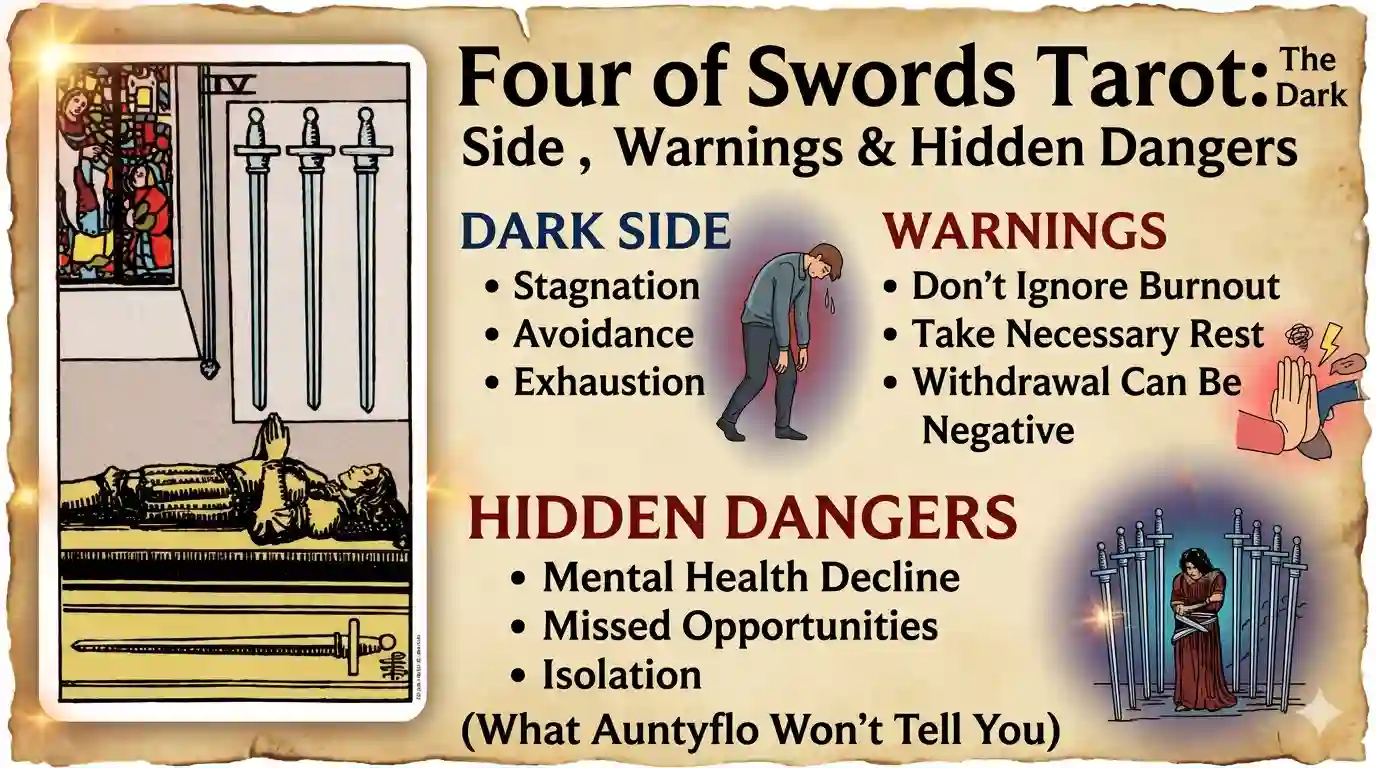
Four of Swords Tarot: The Dark Side, Warnings & Hidden Dangers (What Auntyflo Won’t Tell You)
Fast Answer: Four of Swords Tarot Meaning – The Harsh Truth
If you are looking for a standard, sugar-coated tarot reading, you have likely read that the Four of Swords meaning is all about peaceful rest, necessary recovery, and a beautiful period of healing introspection. Popular sites often portray this card as a gentle, comforting pat on the back—a sign that you simply need a nap and a bubble bath before returning to your inevitably fulfilling life.
The harsh truth is entirely different. The Four of Swords often signals dangerous withdrawal, emotional shutdown, and the profound avoidance of real problems. When this card appears, it frequently serves as a massive red flag that your “rest” has devolved into paralysis. It points to stagnation, creeping depression, or a state of burnout that has already set in so deeply that you have disconnected from your own life.
Instead of a cozy retreat, this card asks you to question your motives. Are you truly recovering, or are you hiding? The negative aspects of Four of Swords reveal a fear of facing life again. It shows a state where temporary relief has become a comfortable cage. To master this card’s energy, you must understand that resting on a tomb is not a long-term survival strategy—it is a temporary pause that, if extended too long, becomes a quiet, invisible surrender.
Four of Swords Tarot: The Shadow Side & Hidden Warnings
To truly understand the Four of Swords shadow side, you must look closely at its traditional imagery. The card depicts a knight lying in state upon a tomb, hands clasped in prayer, with three swords hanging above him and one beneath him. Many mainstream interpretations view this strictly as a sanctuary—a peaceful respite from the chaos of battle. But think deeply about what a tomb actually represents. It is a place for the dead.
This imagery carries a stark, hidden warning. It can symbolize symbolic death and emotional shutdown. The knight is not sleeping in a warm bed; he is mimicking death to avoid the swords (representing thoughts, conflicts, and truths) that surround him. When you draw this card, it is highly likely that your period of “recovery” has crossed the line into dissociation. You are playing dead to avoid the demands of your own existence.
Contrasting sharply with overly encouraging advice, unchecked rest leads to devastating consequences. When you retreat into the energy of the Four of Swords for too long, you miss fleeting windows of opportunity. You deepen your own isolation, making the eventual return to reality feel exponentially more terrifying. The longer you stay on the tomb, the heavier your limbs become. What starts as a necessary weekend of quiet can easily stretch into months of giving up, avoiding responsibilities, and losing your grip on your personal ambitions. The Four of Swords warning is clear: do not let the tomb become your permanent home.
Introduction: Why the Four of Swords Is Not Always Gentle Self-Care
We live in a culture that simultaneously glorifies the grind and romanticizes “burnout culture.” Because so many people are chronically exhausted, the concept of self-care has been packaged and sold as the ultimate remedy for every emotional ailment. When the Four of Swords appears, many tarot readers immediately default to this modern narrative: “You just need to take a break!”
However, this interpretation completely ignores the dangerous reality of when rest becomes avoidance. The Four of Swords frequently appears when a person is using “needing a break” as a shield. It is the perfect excuse to procrastinate on a difficult project, numb out with endless scrolling or binge-watching, or refuse to deal with active conflict and grief.
You might tell yourself, “I am protecting my peace,” when in reality, you are refusing to do the necessary, uncomfortable work of living. The danger of turning a short recovery into long-term stagnation is that you lose your momentum. When you use withdrawal as your primary coping mechanism, your threshold for handling stress shrinks. Eventually, even the smallest inconvenience sends you running back to the safety of isolation. The Four of Swords challenges you to examine whether your current form of self-care is actually self-sabotage wrapped in a cozy blanket.
Spiritual Meaning of the Four of Swords – The Cautionary Message
Peeling back the layers of the Four of Swords reveals a deeply cautionary spiritual message. This card represents a profound test of courage for the human soul. The universe grants you a pause, but the true test is how you utilize that silence. Will you use the pause for genuine integration, healing, and preparation? Or will you hide in spiritual bypassing, using meditation and detachment as excuses to ignore your earthly duties?
On a spiritual level, staying trapped in the Four of Swords energy indicates a severe loss of faith. You have stopped fighting because you no longer believe victory is possible. It represents a disconnection from your own vital life force. Sometimes, the soul forces a shutdown because you have ignored earlier, gentler warnings to change your path. But this forced shutdown is not meant to last forever.
When looking at the Four of Swords reversed, which is often a more common real-world signal, we see the agonizing transition where peaceful rest shatters. The reversed card points directly to restlessness turning into crippling panic, or a forced re-emergence after too much withdrawal. You may find yourself feeling trapped in cycles of withdrawal, unable to stay asleep but terrified to wake up. Spiritually, this card demands that you eventually stand up, reclaim your sword, and trust that the divine will protect you as you step back onto the battlefield of your life.
Psychological Interpretation: When Rest Becomes Avoidance or Depression
To understand the Four of Swords on a practical level, we must view it through the lens of human psychology. The knight resting on the tomb is the perfect visual representation of the nervous system’s “freeze” response. When the mind encounters too much stress, trauma, or conflict (the swords), it does not always fight or flee. Sometimes, it simply shuts down.
This freeze response manifests as dissociation, depressive withdrawal, and a profound fear of vulnerability. You might experience the exhaustion of constant mental battles without any resolution. Your mind runs in circles until it simply collapses under its own weight, leaving you with anxiety that prevents true rest. Even though your body is physically lying down, your brain is still silently fighting the war, completely draining your reserves.
This card heavily links to inner child wounds and learned helplessness. If you were taught that acting out or speaking up only brings pain, your inner child learns to play dead to survive. You might start using concepts like “meditation,” “boundaries,” and “self-care” to completely avoid accountability. You retreat because you feel you cannot handle the demands of others, but beneath the quiet exterior lies suppressed anger beneath the calm surface. You are angry at the world for demanding so much of you, and you are angry at yourself for not being able to meet those demands.
Symbolism Table: Positive vs. Shadow Meanings of the Four of Swords
When interpreting this card, it is vital to contrast the common, uplifting meanings with the harsh realities of the shadow side.
| Tarot Symbol / Element | Standard Positive Meaning (The Illusion) | The Deep Shadow Meaning (The Reality) |
|---|---|---|
| The Knight Lying Down | Peaceful rest, physical recovery, finding sanctuary. | Emotional numbness, playing dead, giving up, profound depression. |
| The Tomb / Sarcophagus | A sacred space, stronger identity through inner reflection. | Stagnation, isolation, self-imposed exile, burying one’s true potential. |
| The Single Sword Beneath | Grounded thoughts, establishing a solid mental foundation. | A constant, lingering threat; the inability to truly relax; buried anxiety. |
| The Three Swords Above | Mental peace, pointing thoughts toward the divine. | Looming problems ignored, procrastination, the exhaustion of unresolved conflict. |
| The Stained Glass Window | Spiritual connection, receiving divine guidance. | Escapism, looking at life through a distorted lens, spiritual bypassing. |
| The Posture of Prayer | Meditation, healthy introspection, seeking inner peace. | Pleading for rescue rather than taking action, learned helplessness, fear of life. |
Common Tarot Scenarios with the Four of Swords (Upright & Reversed)
The Four of Swords manifests its shadow traits differently depending on the area of life you are inquiring about. Understanding these nuances is key to delivering an honest, empowering reading.
Love & Relationships
In romance, the Four of Swords in love is rarely the positive omen people hope for.
Upright: It often signals extreme emotional distance. One or both partners have withdrawn into their own corners. You might see the silent treatment being weaponized and disguised as “needing space.” It points to a profound fear of intimacy, where a person checks out emotionally because resolving the relationship’s issues feels too mentally taxing. The relationship is essentially on life support; it is peaceful only because nobody is moving or speaking.
Reversed: The reversed Four of Swords in relationships indicates that the silent tension is breaking, but rarely in a calm way. The period of isolation has bred intense resentment. You or your partner can no longer maintain the facade of peaceful distance, leading to an explosive release of pent-up frustrations. It signals that avoiding the relationship’s problems has only made them significantly worse.
Career & Money
When asking about business or finances, this card demands a harsh reality check.
Upright: Four of Swords burnout is a very real phenomenon here. This is not just a weekend off; this is a burnout leave that is quietly turning into giving up. You might be engaging in “quiet quitting,” doing the bare minimum while totally checked out of your career goals. It highlights massive procrastination on important tasks, leading to missed opportunities strictly due to inaction. You are avoiding responsibility and leadership because the thought of stepping up feels paralyzing.
Reversed: You are being forced back to work before you are ready, or you are experiencing extreme restlessness because your lack of income or career progress is causing panic. You want to rest, but financial survival prevents it, leading to a state of frantic, ungrounded action that lacks strategy.
Health
Health readings featuring this card require immediate, serious attention.
Upright: The physical or mental exhaustion has already set in. This is not a warning to prevent burnout; the burnout is here. However, the “rest” you are taking is not healing you. You might suffer from severe insomnia, overthinking your life while lying in the dark. There is a massive risk of sliding into a deeper, clinical depression or experiencing a full mental breakdown if this static, unmoving state is prolonged without professional intervention.
Reversed: You are completely denying your body’s desperate plea for rest. You are pushing through illness or mental fatigue, running on empty adrenaline. This reversed state warns that if you do not voluntarily choose to rest, your physical body will fail and force you into a state of recovery, usually at the worst possible time.
Spirituality
In the realm of the soul, the Four of Swords points to dangerous self-deception.
Upright: You are engaging heavily in spiritual bypassing. You might use excessive meditation, retreats, or silence to avoid doing real, messy shadow work. You prefer the quiet withdrawal because it protects you from the chaotic reality of human existence. This prolonged rest results in a tragic loss of personal power in prolonged rest. You are no longer an active participant in your spiritual growth; you are merely a passive observer.
Reversed: A crisis of faith. The quiet sanctuaries no longer bring you peace. You feel entirely disconnected from the divine, struggling with questions of identity after long withdrawal. Your spiritual foundations feel shaky, and you realize that endless meditation cannot fix the practical, earthly problems you have been running from.
Emotional States Reflected by the Four of Swords
When you look at this card, you must connect with the heavy, complex emotions it brings to the surface. The Four of Swords evokes a unique brand of heavy exhaustion mixed deeply with guilt. You know you should be doing something, but you physically and mentally cannot bring yourself to do it.
This state breeds profound numbness. The sharp pain of your daily struggles has dulled into a flat, gray ache. You feel a quiet, creeping dread at the very thought of returning to your normal life. While you isolate yourself to find peace, you ultimately discover an intense loneliness within that isolation. It is a state of quiet despair. You are safe from the swords outside, but you are trapped alone with the echoes of your own mind. When the card is reversed, this numb despair flips into restless, buzzing anxiety—your body wants to move, but your mind remains terrified of the outside world.
Life Situations That Trigger the Four of Swords as a Warning
The negative aspects of Four of Swords show up in highly specific, incredibly realistic daily scenarios. You might find yourself taking a “mental health day” from work, which slowly stretches into a week of doing absolutely nothing, yet you feel zero restoration.
You might start ghosting your friends, family, and responsibilities, convincing yourself that you are just setting “boundaries” and practicing self-care. In reality, you are hiding. The card frequently appears when someone is staying in a highly toxic job or relationship simply by emotionally checking out. You survive the toxicity by going numb.
Other triggers include using physical retreat to avoid processing intense grief, or facing a conflict you know is inevitable. It appears when the burnout is so incredibly severe that merely answering an email or doing the laundry feels like an impossible, monumental task. The card warns you that underlying fears of re-engaging with life are dictating your daily schedule.
Spiritual Lessons from the Shadow Four of Swords
What is this card truly trying to teach you? The core spiritual lesson of the shadow Four of Swords is that rest is absolutely necessary, but it is never sufficient on its own. True healing requires eventual, courageous re-engagement with life.
Avoidance never heals a wound; it only deepens it. If you lock yourself in a sterile room, your immune system weakens. The same is true for your spiritual and emotional resilience. You must eventually face the swords. Integration of your thoughts, your truths, and your conflicts must happen for you to evolve.
Spiritual maturity is not about existing in a permanent state of zen. It means knowing exactly when to rest, and more importantly, knowing exactly when to rise. This card ties deeply to the cycles of symbolic death and rebirth. You are allowed to lay down your armor and mourn what has depleted you. But eventually, the morning comes, the tomb must be opened, and you must step back out into the sun.
Is the Four of Swords a Bad Omen?
Many people fear drawing swords in a tarot reading. So, is the Four of Swords inherently a bad omen? It is not inherently evil, but it is an incredibly serious red flag when it appears repeatedly in your spreads.
When you see this card consistently, especially upright in questions focused on action, career, or active relationship building, it is screaming at you. It is a massive warning that your current strategy of withdrawal is no longer serving you. Your coping mechanism has morphed into a self-destructive habit.
When combined with other heavy cards like the Nine of Swords or the Tower, or when it appears reversed showing severe signs of burnout, it means your avoidance is actively causing you harm. It is not telling you that you are doomed; it is telling you that you are asleep at the wheel of your own life, and if you do not wake up soon, you will crash.
What This Card Is Asking You To Do (Practical Shadow Work Steps)
When the Four of Swords warning sounds, you must take active, practical steps to break the spell of stagnation. It requires gentle but firm action.
First, you must break your isolation. Reach out to one trusted person. You do not have to explain everything; you simply have to remind your nervous system that connection is safe. Set micro-goals to re-engage with your reality. If your whole house is a mess, just clean one counter. If you have been ignoring your finances, just open the app and look at the balance.
Journal intensely about your fears of returning to life. You must start facing yourself in the mirror of stagnation to understand exactly what you are hiding from. Are you afraid of failure? Are you afraid of confrontation? Name the fear.
Balance your rest with very small, deliberate actions. Work intentionally with opposing energies. If you pull the Four of Swords, seek out the energy of the Ace of Wands—find one tiny spark of passion, creativity, or motivation to pull you out of the dark. Seek real, tangible support, such as therapy or counseling, instead of relying purely on solo withdrawal. You cannot always think your way out of a mental trap.
Deep Reflective Passage
The tomb is cold, but it is undeniably safe. When the battles of your life have drawn blood, when the noise of the world has shattered your peace, the heavy stone of the Four of Swords offers a seductive promise: Lie down. Close your eyes. You do not have to fight anymore. And so, you rest. At first, the silence is a medicine, cooling the fever of your burnout. But as the days bleed into weeks, the silence changes. It thickens. It morphs from a sanctuary into a subtle prison.
You lie in the dark, staring at the swords hanging above you, realizing that avoiding the blade does not make it disappear. The true danger of the Four of Swords is not the chaos outside; it is the comfort of the numbness inside. It is the tragic realization that you have grown to prefer the absence of pain over the presence of joy. You have confused playing dead with finding peace.
To rise from this tomb is the hardest task the tarot will ever ask of you. Your limbs will feel made of lead. The fear of picking up the swords again—of caring, of trying, of risking failure and heartbreak—will scream in your mind, begging you to stay in the dark. But you must issues with control through excessive retreat release your grip on this false safety. There is a quiet, monumental power in choosing courageous re-engagement over endless retreat. You were not born to be a beautiful statue on a marble slab. You were born to live, to bleed, to heal, and to rise. Take a breath. Open your hands. Stand up.
FAQs
What does the Four of Swords reversed really mean?
The reversed Four of Swords is a jarring wake-up call. It means your period of rest has been violently interrupted, or you are experiencing extreme restlessness, anxiety, and an inability to relax. It shows that avoiding your problems has only made them louder, and you are now being forced to deal with them head-on, ready or not.
Is the Four of Swords a sign of depression?
It certainly can be. While it traditionally points to rest, in its shadow aspect, it heavily indicates depressive withdrawal, emotional flatlining, and a profound lack of motivation to engage with daily life. If you feel numb and isolated, this card is validating that struggle.
Why do I keep pulling this card when I feel exhausted?
You keep pulling it because your “rest” is not actually restorative. You are physically resting, but your mind is running a marathon of worry. The tarot is demanding that you address the root cause of your exhaustion rather than just slapping a band-aid of temporary isolation over it.
Does it mean I should keep resting or finally act?
If you have just survived a major trauma or conflict, rest. But if you have been stagnant for months, this card is a strict warning that your rest has become avoidance. It is time to take small, gentle steps toward action before the stagnation becomes permanent.
How to handle the Four of Swords in love readings?
Recognize that someone is pulling away. Do not force connection immediately, but do not ignore the distance either. It requires an honest conversation about why the emotional withdrawal is happening. It warns that giving the silent treatment will slowly kill the relationship.
What is the spiritual difference between upright and reversed?
Upright spiritually implies a voluntary, though sometimes excessive, retreat into the self to avoid the world. Reversed spiritually implies being thrust out of your sanctuary, facing a crisis of faith, or dealing with the chaotic consequences of ignoring your spiritual growth.
Can it represent a person? What are their negative traits?
Yes. As a person, they are highly avoidant, emotionally unavailable, prone to ghosting, and deeply fearful of conflict. They will disappear the moment things get difficult, claiming they “need space” but actually lacking the courage to face reality.
How does it connect to burnout?
It is the ultimate burnout card. It shows the moment your nervous system completely shuts down because it can no longer handle the stress you have put it under. It is the consequence of pushing yourself far beyond your natural human limits.
Is prolonged rest ever dangerous?
Absolutely. Prolonged rest degrades your momentum, your confidence, and your connection to the world. It breeds a fear of the outside. Just as a muscle atrophies if it is never used, your emotional resilience wastes away if you stay hidden for too long.
What does it mean for my career?
In career, it warns of severe stagnation. You are not advancing because you have mentally checked out. You are doing the bare minimum to survive, missing out on massive opportunities because you are too exhausted or fearful to grab them.
How does it relate to anxiety?
The shadow of this card highlights the anxiety of avoidance. When you avoid a task or a conversation, the temporary relief is quickly replaced by a looming, heavy dread. You are resting, but you are anxious because you know the sword is still hanging over you.
How does it relate to feeling trapped?
You become trapped by your own coping mechanisms. You build a wall to keep the pain out, but eventually, you realize you have locked yourself inside. The safety measures you put in place have become a suffocating prison.
Can this card indicate a hospital stay?
Yes, in very literal readings, it can point to forced bed rest, illness, or a hospital stay where your body physically forces you to stop moving because you refused to listen to earlier warning signs.
How do I transition out of the Four of Swords energy?
Transition out slowly. Do not jump straight into a chaotic environment. Begin by establishing a small, daily routine. Reconnect with one supportive friend. Do one productive task a day to rebuild your tolerance for action.
What happens if I ignore the warnings of this card?
If you ignore the warning that your rest has become toxic stagnation, you risk severe isolation, the breakdown of your relationships, and a total loss of your personal goals. The longer you stay down, the harder it is to ever get back up. Wake up and gently reclaim your life.


