Dream About Waking Up But Still Dreaming (False Awakening Dreams) – Spiritual Meaning | Symbolism | Interpretations
Fast Answer: Dream About Waking Up But Still Dreaming
To dream about waking up but still dreaming—a phenomenon known as a false awakening—symbolizes blurred awareness, liminal consciousness, incomplete awakening, inner confusion, or a transition between mental states. These dreams reflect moments where the mind believes it has achieved wakefulness while the soul is still processing deeper material beneath the surface.
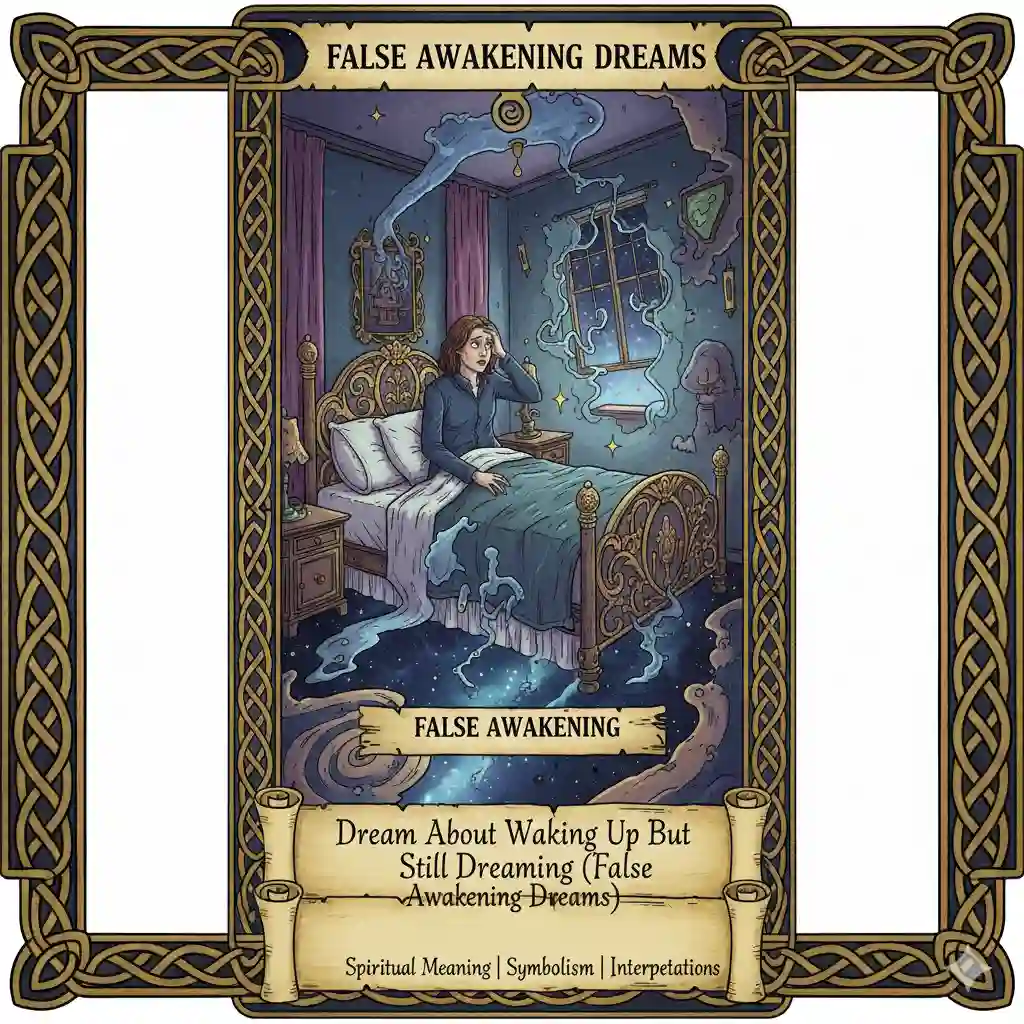
These experiences are not signs of madness or loss of control, but rather indicators of a mind that is hyper-vigilant or deeply engaged in processing. They represent a threshold state where the boundary between the subconscious and conscious mind becomes permeable. A dream of false awakening suggests you are in a state of preparation, rehearsing for a new reality or struggling to discern between what is real and what is perceived. It is a sign of a psyche that is eager to wake up, yet still needs time to fully integrate the lessons of the subconscious.
Introduction: What Are False Awakening Dreams?
False awakening dreams are vivid, hyper-realistic experiences where you dream that you have woken up, only to realize later—either by “waking up” again or noticing an anomaly—that you are still asleep. In these dreams, you might perform your usual morning routine: getting out of bed, brushing your teeth, checking your phone, or starting breakfast. The sensory details are often incredibly sharp, mimicking reality so closely that the mind accepts the dream as the waking world.
This phenomenon differs from a standard dream because of its mundane realism and its specific focus on the act of waking. Unlike lucid dreams, where you become aware you are dreaming and can control the narrative, false awakenings usually involve a lack of awareness until the illusion breaks. They are distinct from sleep paralysis as well, as you typically feel free to move and act within the dream environment.
These dreams often occur during periods of high stress, intense self-reflection, or spiritual growth. When the mind is overactive or deeply concerned with “getting things right” in daily life, it may simulate the start of the day before the body is actually ready to rise. It is a mental rehearsal, a sign that your consciousness is hovering in the liminal space between deep rest and active engagement, unsure of which realm it currently inhabits.
Spiritual Meaning of False Awakening Dreams
Spiritually, false awakening dreams represent the “in-between” phases of the soul’s journey. They symbolize the liminal states between awareness and unconsciousness, where you are neither fully asleep to your potential nor fully awake to your spiritual reality. The spiritual meaning of false awakening dreams often points to a partial awakening of consciousness. You may feel that you have understood a spiritual lesson or reached a new level of clarity, only to realize there are deeper layers yet to uncover.
These dreams can be seen as the soul testing your awareness and presence. They challenge you to discern between illusion and clarity. Just as you must look closely at the dream world to realize it isn’t real, you may be called to look closely at your waking life to see where you are operating on autopilot or accepting illusions as truth. It is an invitation to deepen your perception.
Furthermore, this dream about waking up but still dreaming can symbolize the concept of “waking up” within the spiritual metaphor. It suggests that enlightenment or true understanding is not a single, sudden event, but a process of peeling back layers. You wake up from one level of understanding only to find yourself in another, slightly larger container of reality. It is a lesson in humility and the infinite nature of spiritual growth.
Psychological Interpretation of Waking Up but Still Dreaming
Psychologically, false awakenings are often linked to anxiety and mental hyper-vigilance. If you are stressed about the day ahead, your brain may prematurely activate the neural pathways associated with your morning routine. The mind is so fixated on the tasks to be done—the meeting, the travel, the conflict—that it begins to simulate them before you physically wake up. This reflects a difficulty in fully resting or switching off; your “doing” mode is intruding on your “being” mode.
These dreams can also point to dissociation or overthinking. When we live too much in our heads, constantly analyzing and monitoring our experience, we can create a sense of detachment from reality. A false awakening mirrors this state: you are observing a simulation of life rather than living life itself. It suggests a habit of self-monitoring where you are constantly checking, “Am I okay? Is this right? Am I awake?”
Additionally, this phenomenon represents the mind rehearsing wakefulness. It is a form of anticipation. If you are expecting a significant event or change, your psyche practices the transition. It highlights a state of high alert where the boundary between internal thought processes and external reality is temporarily blurred due to mental fatigue or intense focus. It is not a malfunction, but a reflection of a mind that is working overtime.
Symbolic Meaning of False Awakening Elements
The specific details within a false awakening dream provide clues to the nuances of your internal state. Since the setting is usually familiar, small deviations hold significant symbolic weight.
| Dream Symbol | Symbolic Interpretation |
|---|---|
| Bedroom Setting | Represents your most private self and your state of rest. Changes here symbolize disruptions to your inner peace or privacy. |
| Alarm Clocks | Symbolize urgency, deadlines, and the pressure of time. A silent or malfunctioning alarm points to anxiety about missing opportunities or being unprepared. |
| Attempting to Move or Speak | Reflects feelings of restriction or a struggle to express your true self in your waking life. It highlights a disconnect between your will and your actions. |
| Checking Time or Phone | Represents a need for orientation and connection. It suggests a dependency on external validation or a fear of being out of the loop. |
| Seeing Familiar People | Indicates that your confusion or transition involves your relationships. Their behavior in the dream reflects your subconscious projections or expectations of them. |
| Repeated Awakenings | Symbolize feeling stuck in a loop or cycle. It suggests you are trying to solve a problem using the same mindset that created it, needing a true shift in perspective. |
When analyzing the waking up inside a dream interpretation, pay attention to the lighting, the atmosphere, and your emotional reaction to the anomalies. These subtle cues reveal whether you are feeling safe in your transition or threatened by the confusion.
Common False Awakening Dream Scenarios & Interpretations
The narrative structure of false awakenings can vary, and each variation offers a different lens on your subconscious state.
Waking Up in Your Bed but Realizing It’s Still a Dream
This is the classic scenario. You get up, perhaps start your day, and then notice something is “off”—the light switch doesn’t work, or the room is slightly different. This symbolizes the dawn of awareness. You are beginning to question the status quo of your life. It suggests that something in your waking reality feels inauthentic or constructed, and your intuition is signaling that you need to look closer at what you accept as “normal.”
Multiple False Awakenings in One Night
Dreaming of waking up repeatedly—a nested loop of awakenings—can be disorienting. This scenario often reflects a feeling of being trapped in a cycle or a routine in your waking life. You may feel like you are making progress (waking up), only to find yourself back where you started (still dreaming). It is a powerful symbol of feeling trapped dream meaning, indicating that your current efforts to change your life are superficial and a deeper, more radical shift is required.
Trying to Scream or Move but Failing
Sometimes a false awakening transitions into a state resembling sleep paralysis within the dream. You think you are awake but cannot move or call for help. This reflects deep-seated anxiety and a feeling of powerlessness. It suggests you are aware of a problem in your life but feel unable to voice it or take action. This connects closely with the anxiety dream meaning, highlighting a freeze response to stress.
Thinking You’re Late or Missing Something
In these dreams, you wake up in a panic, believing you have overslept. You rush to get ready, only to wake up for real and realize it was a dream. This is a clear manifestation of performance anxiety and the pressure to succeed. It reflects a fear of letting others down or falling behind. It links to the symbolism found in being late dream meaning, emphasizing internal pressure and time scarcity.
Performing Normal Routines Inside the Dream
Dreaming of brushing your teeth, showering, or making coffee signifies a desire for order and normalcy. If your waking life feels chaotic, your mind creates a safe, predictable routine in the dream state to self-soothe. It represents a need for grounding and a return to basics.
Becoming Aware You’re Still Dreaming
This is the moment of lucidity. Realizing you are dreaming while still in the dream state represents a breakthrough in consciousness. It symbolizes the development of higher awareness and the ability to observe your own thoughts and reactions without being swept away by them. It is a sign of spiritual maturity and the development of the “witness” consciousness.
Emotional States Reflected by False Awakening Dreams
The emotions you experience during the false awakening are key to unlocking its personal meaning.
Confusion: The primary emotion is often disorientation. This reflects a waking life state where you are unsure of your direction or your truth. You may be grappling with conflicting information or struggling to make a decision. This links directly to the confusion dream meaning, suggesting a need for mental clarity.
Anxiety: If the dream is frantic or filled with dread, it mirrors your waking stress levels. It suggests you are living in a state of hyper-arousal, constantly waiting for the other shoe to drop.
Curiosity: Sometimes, the realization that you are dreaming brings a sense of wonder. You might explore the dream bedroom with fascination. This reflects an open, inquisitive mind that is ready to explore the deeper mysteries of the self and the universe.
Loss of Control: The inability to wake up for real can trigger feelings of helplessness. This reflects a fear that you are not the captain of your own ship, that forces beyond your control are dictating your reality. This ties into the broader control dream meaning.
Heightened Awareness: Upon realizing the deception, you may feel hyper-aware. This reflects a state of vigilance where you are acutely tuned in to your environment, perhaps to a fault.
Relief Upon True Waking: The flood of relief when you finally wake up signals that you have been carrying a heavy mental load. It suggests a deep need for resolution and the comfort of reliable reality.
False Awakening Dreams & Life Transitions
False awakening dreams are particularly common during major life transitions. When your identity is shifting—graduating, changing jobs, becoming a parent, moving—your internal sense of reality becomes fluid. The “old you” is fading, but the “new you” hasn’t fully arrived.
In this context, the dream about waking up but still dreaming reflects this transitional psychological phase. You are “waking up” to a new life stage, but the process is layered and complex. You may feel like you are going through the motions (the false awakening) in your new role, feeling like an imposter or unsure if this new reality is permanent.
These dreams can also signal mental overload. When the brain is processing vast amounts of new information, it may struggle to cycle through sleep stages smoothly, leading to these glitch-like dream experiences. It is a sign that your processing centers are working at capacity to integrate your new experiences.
Furthermore, they highlight emotional processing that is not yet completed. You may think you have “woken up” and moved on from a past hurt, but the dream shows you are still in the bedroom of your subconscious, processing the remnants of that emotion. It is a gentle reminder that healing is non-linear.
False Awakening vs. Related Dream Types
It is helpful to distinguish false awakenings from other sleep phenomena to understand their specific symbolic message.
False Awakening vs. Lucid Dreaming:
In a lucid dream, you know you are dreaming and can control the environment. In a false awakening, you believe you are awake. The key difference is awareness. Lucid dreams symbolize empowerment and active engagement with the subconscious. False awakenings symbolize the search for awareness and the deceptive nature of perception.
False Awakening vs. Sleep Paralysis:
Sleep paralysis involves being awake but unable to move, often accompanied by hallucinations of a presence in the room. It is a physiological state. False awakenings are dreams where you can usually move and act, even if the environment is strange. False awakenings are more about confusion of reality than physical entrapment.
False Awakening vs. Recurring Dreams:
Recurring dreams replay the same narrative theme over time. False awakenings replay the specific act of waking up. While false awakenings can be recurring, their focus is specifically on the threshold of consciousness and the transition from sleep dream meaning to wakefulness.
False Awakening vs. Looping Dreams:
Looping dreams involve repeating a sequence of events within a dream. A series of false awakenings is a specific type of loop. The symbolism focuses on the difficulty of breaking through a barrier or moving to the next level of awareness.
Spiritual Lessons of False Awakening Dreams
These dreams offer profound spiritual teachings if we approach them with patience.
Awareness Is Gradual: The primary lesson is that awakening is rarely a lightning bolt; it is a dawn. It happens in stages. We peel back one layer of illusion only to find another. This teaches us patience with our spiritual progress.
Presence Develops Through Observation: To realize you are in a false awakening, you must observe details closely. This trains the spiritual muscle of presence. It teaches us to question our assumptions and look deeply at our reality to see what is true. This is the core of awareness dream meaning.
Learning Patience with the Mind: These dreams can be frustrating. They teach us to be gentle with our own minds. The confusion is not a failure; it is part of the process of sorting through complex inner worlds.
Discernment Between Perception and Reality: False awakenings are the ultimate test of discernment. They ask us: How do you know what is real? Spiritually, this points to the concept of Maya (illusion) and the journey to discover the ultimate truth behind the veil of physical existence.
Gentle Awakening Rather than Forceful Insight: The dream suggests that sometimes we need to wake up gently. Rushing the process only leads to confusion. We must allow our consciousness to emerge in its own time.
Are False Awakening Dreams Warnings or Invitations?
Depending on the emotional tone, a dream about waking up but still dreaming can be either a warning or an invitation.
As a warning, these dreams signal mental exhaustion. If the dream feels stressful, claustrophobic, or frantic, it warns that your mind is overactive and you are not getting deep, restorative rest. It suggests that your anxiety about the waking world is polluting your sanctuary of sleep. It is a sign to slow down and reduce the input you are consuming.
As an invitation, these dreams call for deeper self-awareness. If the dream feels curious or simply confusing, it invites you to question your reality. It asks you to become more lucid in your waking life—to stop living on autopilot and start engaging consciously with your day. It invites you to explore the nature of your own consciousness and to bridge the gap between your inner and outer worlds.
The difference lies in the feeling: fear signals a need for rest; curiosity signals a need for exploration. In both cases, the dream is a guide, helping you navigate the complex reality dream meaning of your existence.
What Your False Awakening Dream Is Asking You to Do
To integrate the wisdom of a false awakening, consider these grounded practices:
Rest the Mind Intentionally: Since these dreams often stem from a hyper-active brain, practice intentional downtime before bed. disconnect from screens, engage in calming activities, and signal to your body that the day’s work is done.
Reduce Hyper-Vigilance: If you are constantly checking for threats or mistakes in your waking life, your dreams will reflect this. Practice trusting that you are safe and that things will unfold as they should. Soften your gaze on your life.
Ground Awareness in Waking Life: Perform “reality checks” during the day. Ask yourself, “Am I awake?” Look at your hands, check the time, or observe your environment closely. This habit of mindfulness can help ground you and may even trigger lucid dreaming, turning confusion into clarity.
Create Emotional Closure: Before sleeping, try to resolve the emotions of the day. Journaling can help “dump” the mental load so your brain doesn’t have to keep processing it in loops while you sleep. This is part of a healthy awakening dream meaning process.
Practice Presence Without Control: Learn to observe your thoughts without needing to manage them. Allow confusion to exist without panicking. Trust that clarity will come naturally when the mind settles.
Deep Spiritual Message of False Awakening Dreams
False awakenings remind us that consciousness does not switch on instantly—it unfolds, layer by layer, through awareness and patience. They teach us that the journey from sleep to wakefulness, from ignorance to understanding, is a path of many steps. These dreams ask you to trust the process of your own unfolding. Even when you feel confused, even when you are not sure if you are fully “awake” to your life’s purpose, you are exactly where you need to be. You are in the threshold, the sacred space of becoming. Be patient with your soul as it rubs the sleep from its eyes. The true awakening is coming, not by force, but by the gentle, persistent dawn of your own awareness.
Frequently Asked Questions (FAQs)
1. What does it mean to wake up but still be dreaming?
To dream of waking up while still asleep—a false awakening—symbolizes a state of transition or confusion. It suggests your mind is active and rehearsing for the day ahead, or that you are in a liminal space between unconsciousness and awareness. It often reflects a desire for a fresh start or anxiety about upcoming responsibilities.
2. Are false awakening dreams dangerous?
No, they are not dangerous. They can be disorienting or frustrating, but they are a natural phenomenon of sleep. They do not indicate mental illness or physical harm. They are simply a sign that your brain is in a highly active state during REM sleep.
3. Why do false awakenings feel so real?
They feel real because the brain uses your most familiar memories—your bedroom, your bed, your morning routine—to construct the dream. The sensory details are drawn from your daily habit loops, making the simulation incredibly accurate and convincing to the dreaming mind.
4. Are false awakenings linked to anxiety?
Yes, there is often a strong link. People with high levels of stress, anxiety, or sleep disturbances are more prone to false awakenings. The mind’s hyper-vigilance prevents it from fully settling into deep, unconscious sleep, leading to dreams that mimic wakefulness.
5. Can false awakenings be spiritual experiences?
Absolutely. They can serve as powerful metaphors for spiritual awakening. They challenge you to question the nature of reality and illusion. They can prompt a deeper inquiry into what it means to be truly “awake” versus living in a state of spiritual slumber.
6. How do I stop having false awakening dreams?
To reduce these dreams, focus on reducing stress and improving sleep hygiene. Establish a calming wind-down routine. Avoid caffeine or heavy meals before bed. Addressing underlying anxiety through meditation or therapy can also help quiet the mind and allow for deeper, uninterrupted sleep.
7. Is a false awakening a lucid dream?
Not necessarily. In a false awakening, you usually believe you are awake and are not aware you are dreaming. However, a false awakening can turn into a lucid dream if you notice an anomaly (like a clock reading the wrong time) and realize, “Wait, I am dreaming.”
8. Why do I have multiple false awakenings in a row?
“Looping” false awakenings usually indicate a feeling of being stuck or trapped in a situation in your waking life. Your mind is trying to “boot up” or solve a problem but keeps hitting a snag. It reflects a need to break a cycle or change your approach to a recurring issue.
9. What does it mean if I see a scary figure during a false awakening?
This often blends with sleep paralysis or night terrors. The scary figure represents a shadow aspect of yourself or a fear you are unwilling to face. Because you think you are awake in your safe space (your bedroom), the intrusion of a scary figure symbolizes anxiety invading your sanctuary.
10. Do these dreams mean I am not sleeping well?
They can indicate that your sleep is fragmented or that you are spending a lot of time in REM sleep (where dreaming occurs) without enough deep sleep. If they happen frequently and leave you tired, it may be worth looking into your sleep quality.
11. Can false awakenings predict the future?
No, they are generally not predictive. They are reflective of your current mental state, your anticipations, and your anxieties about the immediate future (like waking up on time), but they do not prophesy external events.
12. Why do I try to turn on lights in these dreams and they don’t work?
This is a very common reality check failure in dreams. The logic center of the brain that controls cause-and-effect (switch flips -> light comes on) is often dormant during sleep. Symbolically, the inability to shed light on a situation represents confusion or a lack of clarity in your waking life.
13. What is the “liminal state” mentioned in interpretations?
The liminal state is the threshold or bridge between two states of being. In this context, it is the space between sleeping and waking, or symbolically, the space between your old self and your new self. False awakenings take place in this threshold.
14. Are false awakenings related to out-of-body experiences (OBEs)?
Some spiritual traditions believe false awakenings can be a precursor to OBEs. The sensation of floating or moving in your room while your body is asleep shares similarities. However, psychologically, they are distinct phenomena, with false awakenings being firmly rooted in dream imagery.
15. What should I do immediately after waking up from one?
Ground yourself. Sit up, drink water, touch a physical object, or look out the window. Remind yourself that you are now truly awake. Acknowledge the confusion without judgment, and perhaps jot down the dream to clear it from your mind before starting your day.


