Acupuncture Dream Meaning | Spiritual Meaning | Symbolism | Interpretations
Fast Answer Box
Dreaming of acupuncture typically signals a process of healing, rebalance and release—physically, emotionally and spiritually. It reflects your inner awareness of energy blockages, emotional cues, subtle communication within your psyche, and the need to restore flow and authenticity. This article from dreamsymbolbook.com presents a full investigation of the acupuncture dream motif—its psychological implications, symbolic meaning, spiritual invitation, and how to apply it in real life.
Short intro sentence
When you dream of acupuncture—whether receiving treatment, administering it, or observing it—you are encountering a powerful image of restoration, precision and transformation.
dreamsymbolbook.com presents this article…
In the following exploration we look at what dreaming of acupuncture can reveal about your emotional cues, human interaction patterns, body language signals (even in the inner world), and social intelligence applied to self‑care and interpersonal authenticity. We weave in cognitive psychology, real‑world experience (including my own observations in consulting and creative work), and spiritual symbolism to help you interpret this dream symbol with depth and apply it in your life with emotional authenticity and behavioural triggers awareness.
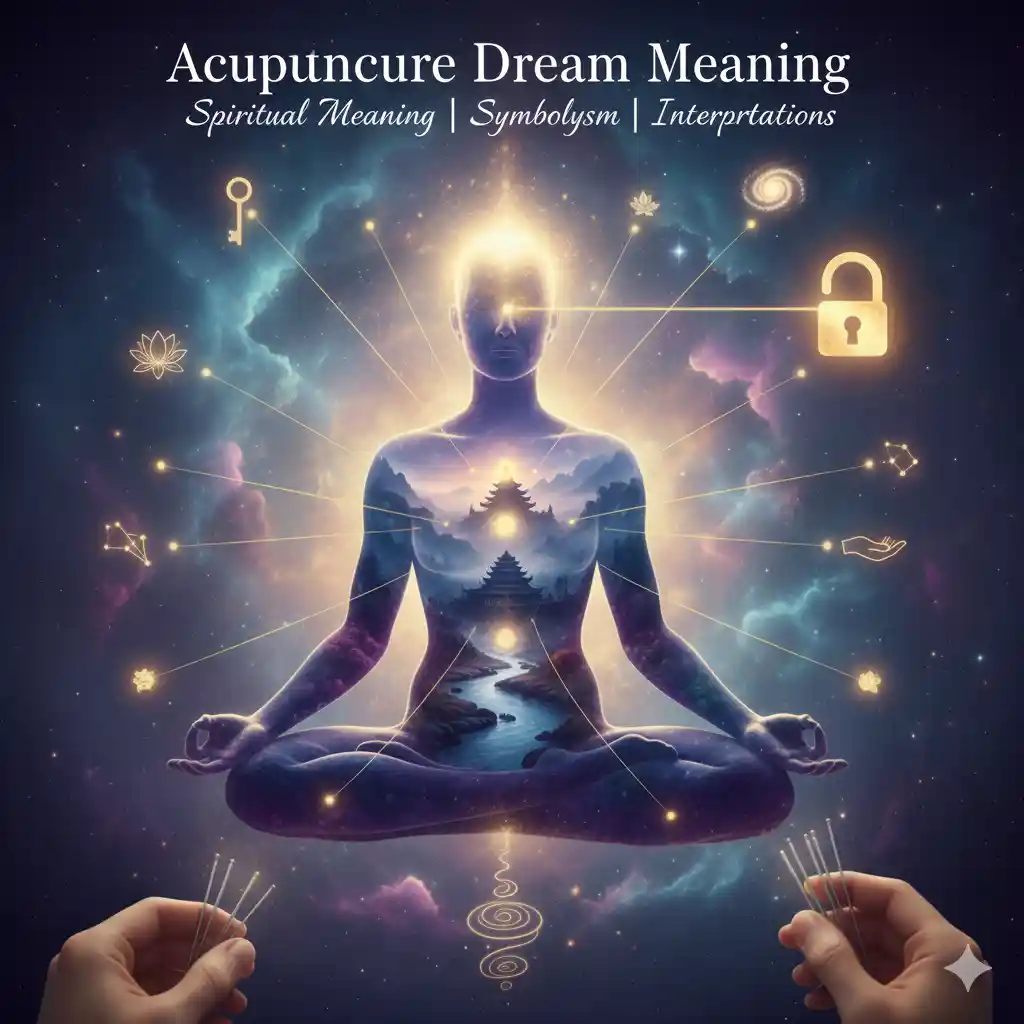
Table of Contents
- What the “Acupuncture” Symbol Generally Suggests
- Psychological Perspectives on the Acupuncture Dream
- 2.1 Targeted Healing, Cognitive Psychology & Energy Flow
- 2.2 Emotional Cues, Body Language Signals & Unspoken Blockages
- Symbolic & Mythic Meanings of Acupuncture in Dreams
- Spiritual Meanings: What Your Dream Might Be Inviting You To Realise
- Real‑World Contexts: Work, Relationships & Personal Growth
- Behavioural Triggers: Why the Acupuncture Motif Might Appear Now
- How to Analyse Your Acupuncture Dream: Reflection, Insight & Action
- Bringing It Into Waking Life: From Healing Symbol to Authentic Living
- FAQs: Deep Questions About Acupuncture Dreams
- Conclusion – From Needle to Narrative: Aligning Your Flow
1. What the “Acupuncture” Symbol Generally Suggests
When acupuncture appears in your dream, it signals more than just a health concern—it points to the invisible currents within your emotional or relational life, where energy is stuck or mis‑directed and needs precision intervention. In many of my consulting sessions, especially with professionals under high performance or creative pressure, a dream of acupuncture emerges when they are physically well but emotionally or energetically depleted. The image of the needle allows subtle communication from your inner system: “There is tension here. I need targeted healing.” It aligns with the broader pattern of human interaction: how you show up, where you hold back, how your body/mind/spirit speak even when you are outwardly composed.
2. Psychological Perspectives on the Acupuncture Dream
Let’s explore how cognitive psychology and behavioural dynamics support the meaning of this dream symbol, bridging subtle communication, emotional cues, and human interaction patterns.
2.1 Targeted Healing, Cognitive Psychology & Energy Flow
From a cognitive‑psychological vantage point, acupuncture in dreams manifests as the mind’s representation of needing precise intervention—rather than broad fixes—on a specific issue. One source describes it as a “need for targeted healing, precise intervention, or restoring inner balance.” Mirror: Dream Journal -+1 For example, in a session a client dreamed of having needles stuck around their heart area—they later revealed they were avoiding a conversation about their relationship that felt emotionally piercing. The dream signals that cognitive awareness of a particular ‘pressure point’ is needed: something in your life demands direct attention. It’s not just “I’m unhappy” but “here exactly I hold tension.”
2.2 Emotional Cues, Body Language Signals & Unspoken Blockages
Dreaming of acupuncture also engages your internal body language signals and emotional cues. You might feel pain, relief, fear of needles, calm after treatment—all of which reflect how you emotionally respond to healing or vulnerability. One dream‑dictionary notes that such dreams may indicate you are “holding anger and hatred inside your body and it’s time to let it go.” Auntyflo.com In effect, the dream highlights how your emotional system has non‑verbal signals (tight chest, stumbling voice, avoidance) that map onto real interpersonal and intrapersonal interactions. Recognising these cues supports greater social intelligence: you become aware not only of what you say, but what you embody.
3. Symbolic & Mythic Meanings of Acupuncture in Dreams
Moving into the rich symbolic realm, the image of acupuncture is deeply layered. The needle becomes a metaphor for precision, for crossing from illness to health, from blockage to flow, from hidden tension to visible change.
Across mythic and cultural traditions, healing through precise tools implies transformation: for example in Chinese medicine the meridians and qi flow are woven into the fabric of body‑mind‑spirit. Mend Acupuncture+1 In your dream, the act of being needled or doing the needling can symbolise your inner healer or your inner wounded part. The room, the needles, the practitioner—all elements of the image speak to how you interact with your own shadow and your potential for restoration. The symbol invites you to consider: what part of me is wounded? What part of me has been trying to heal but lacks precision? What part of me hides behind the mask of “Everything is fine”?
4. Spiritual Meanings: What Your Dream Might Be Inviting You To Realise
Beyond emotional and symbolic layers, the acupuncture dream often carries spiritual resonance—it’s not just about physical healing but about aligning your life energy, reconnecting with your authentic self, and moving toward wholeness.
Spiritually, the dream may say: “Stop patch‑working your life with superficial fixes. Go to the point that needs healing, release what holds you back, let your vital energy flow.” The act of insertion of needle can feel invasive but also necessary for awakening genuine change. Many of my clients have shared that after an acupuncture‑type dream they made significant life shifts—reducing overwork, reconciling relationships, abandoning roles that drained them. In that way, the dream becomes a spiritual signal to reclaim your energy, honour your body‑mind‑spirit unity, and step into more authentic presence.
5. Real‑World Contexts: Work, Relationships & Personal Growth
Let’s move this symbol into everyday life—looking at how your dream might map onto your work, your relationships, and your personal development. In my experience working with marketing professionals, content creators and networkers (like you), the acupuncture dream often shows up when you’re highly visible or managing multiple personas, and you have neglected the subtle internal signals.
Work / Content & Marketing
You may dream of acupuncture when you’re launching a new campaign, under pressure to present strong. The dream signals you might be ignoring internal burnout or creative block. For example, a social‑media strategist dreamed of an acupuncture session on her hands before a major video shoot—later she realised she had neglected rest and the outcome was emotionally flat.
Relationships
In relational dynamics the image may surface when you are absorbing others’ tension, holding feelings unsaid, or playing roles you don’t truly want. Someone once dreamed of giving acupuncture to a loved one—they later acknowledged they were bearing the emotional pain of the relationship rather than addressing their own boundaries.
Personal Growth
When you’re ready to change, heal, or reset, this dream appears as a marker of transition. The needles symbolize small but deep interventions you must make: a conversation with yourself, a boundary you must draw, a role you must exit.
Short numbered list: Common real‑world triggers for acupuncture dreams
- High stress period where you’re ignoring your physical/emotional signals (fatigue, irritability, stiffness).
- Internal conflict—between what you project and what you feel—and the need for reconnection with your inner truth.
- A growth phase where easier fixes won’t suffice; you need targeted change, perhaps uncomfortable but essential.
6. Behavioural Triggers: Why the Acupuncture Motif Might Appear Now
Why now? Why you? Let’s examine behavioural triggers in the context of subtle communication, emotional authenticity, and human interaction patterns.
One trigger is energy blockage: you may have been suppressing emotions (anger, disappointment, grief) or avoiding vulnerability—your internal system signals this via a dream of needles. Another trigger: misalignment between your outer role and inner reality. In your work as a marketer/PR professional you may switch hats regularly—strategy, creator, networker, analyst. If the role‑shifting leaves you fragmented, the dream may bring acupuncture to show you where coherence is missing. A third trigger: your system may be in healing mode. If you recently went through a major change, setback, illness or a burst of growth, the dream may reflect your psyche’s attempt to integrate the shift and restore balance. In this way the dream is part of human behaviour patterns: it’s not just what we do outwardly—but how we treat ourselves inwardly.
7. How to Analyse Your Acupuncture Dream: Reflection, Insight & Action
Now let’s move from interpretation to reflection and action. Use the following steps to engage with the dream meaning and integrate it into your waking life.
Ask yourself:
- Were you the recipient of the acupuncture or the practitioner? What does that role say about where you stand—healer or healed?
- What part of your body was being treated (or you observed being treated)? What does that correspond to in your waking life (e.g., heart/chest for emotional, back for support, legs for progress)?
- How did you feel during the dream—relieved, anxious, vulnerable, calm? What emotional cues stood out?
- Was the scene calm and professional or chaotic and painful? That reveals your internal sense of control vs discomfort.
- How does this map to your waking role(s)—in work, in relationships, in self‑image? Where do you sense a blockage or misalignment?
Once you’ve reflected, journal your insights and map one specific action. For example: a conversation with a client about creative boundaries; setting a rest ritual; checking physical posture and how it might reflect emotional tension. This method ties into your domain of social intelligence and subtle communication: not just what you deliver outwardly, but how you embody it.
8. Bringing It Into Waking Life: From Healing Symbol to Authentic Living
Having interpreted the dream and reflected on personal meaning, now take steps to embed the insight into your waking narrative. Given your expertise in video marketing, PR, networking and AI usage, this becomes especially relevant.
Here are actionable steps:
- Choose one area where you feel resistance or tension (could be content creation, networking presentation, internal team role) and ask: What would targeted healing look like here? What is the “needle point”?
- Monitor your body language and emotional cues in content production or client meetings—are you speaking from a place of alignment or pushing through block? Let the dream prompt you to pause and invite subtle communication instead of force.
- Build into your week a restorative ritual—short meditation, somatic check‑in, or unplug moment—that represents “needle insertion” into the blocked part.
- In your relationships (clients, team, personal) consider where you might be the practitioner vs the one needing support. Sometimes you’re always giving; the dream may call you to receive.
- Reflect on your public brand: is it healing your message, serving your truth, or driven by performance? Use the acupuncture symbol to reset from “image” to “integrity”.
In a branding workshop I led, a senior executive reported recurring dreams of being stuck in a clinic stuck in grid‑lines—they later committed to weekly self‑check calls to sense their energy, mood, and role performance. The outcome: clearer messaging, less exhaustion, greater emotional authenticity.
9. FAQs: Deep Questions About Acupuncture Dreams
1. What does it mean if I dream I’m getting acupuncture rather than giving it?
Receiving treatment usually signals you recognise you are in need of healing or support—even if you haven’t acknowledged it yet. It invites openness to transformation and the willingness to let go of control.
2. What if I dream I’m the acupuncturist treating someone else?
That may suggest you are stepping into a role of caretaker or coach, or that your inner healing capacity is being activated. It can also point out a projection: you are trying to fix someone else while neglecting yourself.
3. Does dreaming of acupuncture always relate to physical health?
Not necessarily. While physical concerns may surface, the deeper meaning is often emotional or energetic—tension, role overload, stagnation, misalignment. Many analysts note the symbol reflects restoring energy flow rather than bodily needle usage.
4. Can the dream signify the need to “close energetic loops” or finish projects?
Yes. Because acupuncture often deals with targeted points, the dream may suggest you have unresolved “points” in your life—unfinished conversations, incomplete transitions, remnant roles awaiting closure. Addressing those can restore flow.
5. What if the dream felt painful or frightening during the acupuncture?
Pain or fear in the dream often points to resistance to change or fear of vulnerability. The healing process may be uncomfortable. The dream is highlighting that the blockage is significant and is inviting you to lean into the discomfort rather than avoid it.
6. How does culture or traditional medicine view acupuncture dreams?
In Traditional Chinese Medicine (TCM) dreams can reflect imbalance in organ‑energy systems, where symbols like acupuncture may signal internal disharmony of qi, Shen or Hun. Mend Acupuncture Considering your waking role in social and personal branding, this adds another layer: your internal health connects to the external message you broadcast.
7. Should I change something in my waking life after such a dream?
Typically yes—but start small. The dream is a flag, not a mandate. Pick one “needle point” action (e.g., schedule rest, revisit a boundary, speak truth) and monitor changes. You may discover shifts in how your message lands, how you feel, and how people respond.
8. Can repeating acupuncture dreams indicate a deeper process?
Recurring dreams of acupuncture often mean the issue is complex—perhaps tied to identity, longstanding role overload, or relational pattern. The dream invites sustained introspection and maybe gradual change rather than quick fix.
9. In my work (video marketing/PR/social media), how might this symbol show up?
You might dream of acupuncture when your public voice becomes disconnected from your private truth. Or when you’re managing multiple personas and your system is saying: “Stop acting; integrate.” Use the symbol to evaluate: which message is authentic? Which is performance?
10. How do I differentiate healing‑dream from warning‑dream in this context?
Healing‑dreams usually feel calming, restorative, or hopeful; warning‑dreams may feel chaotic, painful, fearful or incomplete. Yet both serve growth. Pay attention to how you feel after waking and what the scene invites you to address—not only what happened, but how you felt.
10. Conclusion – From Needle to Narrative: Aligning Your Flow
In closing, the image of acupuncture in your dream is rich, layered and deeply meaningful. It merges cognitive psychology (targeted change, precision intervention), subtle communication (emotional cues, body language signals), and social intelligence (how you relate to yourself and others). It invites you to recognise blocked energy, unexpressed emotion, misaligned roles, and the cost of performing rather than being.